Aquinas Conference 2026: The Beauty of Truth
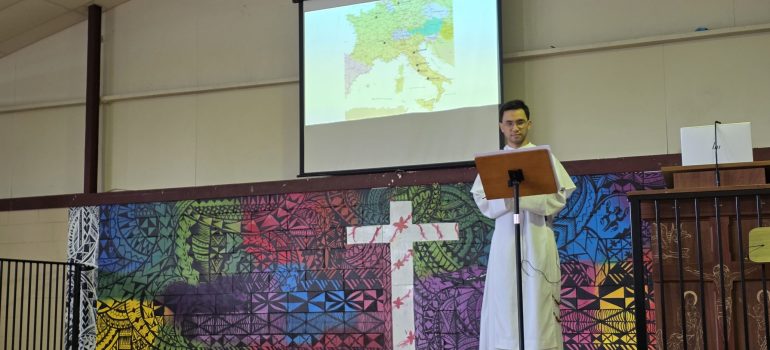
On Saturday we had the Aquinas Conference in Auckland. In the first talk “Portraits of a Saint,” Br Kolbe Garcia offered a deeply human portrait of St Thomas Aquinas, arguing that the essence of Thomas’s holiness lay in a life of contemplation expressed through preaching—the Dominican charism of contemplare et contemplata aliis tradere (“to contemplate and to hand on to others the fruits of contemplation”).
Br Kolbe began with the famous moment near the end of Aquinas’s life when, after a mystical vision, Thomas declared that all he had written was “straw” compared to what he had seen. This remark, Br Kolbe suggested, revealed the heart of Thomas’s sanctity: he had spent his entire life seeking direct knowledge of God, and even his extraordinary theological output had been only a faint reflection of the divine reality he perceived in prayer.
The talk traced Thomas’s life from his noble upbringing in the county of Aquino. His family, hoping for prestige, placed him as a child oblate at Monte Cassino, where he absorbed Scripture, the Divine Office, and the monastic rhythm of contemplation. Even as a boy, he reportedly asked profound questions—most famously, “What is God?”—foreshadowing his lifelong intellectual thirst.
At Naples, Thomas encountered Aristotle and the newly founded Dominican Order. Drawn by their blend of study and preaching, he joined them despite fierce family opposition. His brothers kidnapped him and held him under house arrest for a year, during which, according to tradition, he memorised much of Scripture. When a prostitute was sent to tempt him, Thomas drove her out with a burning ember, after which angels were said to have brought him a belt symbolising purity. Eventually his mother relented, helping him escape and return to the Dominicans.
Thomas’s academic formation continued under St Albert the Great in Cologne, where his quiet manner earned him the nickname “the Dumb Ox.” Albert, recognising his brilliance, famously predicted that “his bellowing will be heard throughout the world.”
As a master of theology at the University of Paris, Thomas produced major works, including his commentary on the Sentences. Later, in Orvieto, he composed the Catena Aurea and the liturgy for Corpus Christi, revealing not only intellectual clarity but profound Eucharistic devotion.
His greatest work, the Summa Theologiae, was begun in Rome as a systematic, accessible guide for students of theology. Its structure reflected a vision of reality in which all things proceeded from God and returned to Him—a pattern of exitus and reditus. Thomas’s productivity was immense; he often dictated to multiple secretaries at once, continuing even half‑asleep.
In his final years, his contemplation deepened into mystical experience. After completing his treatise on the Eucharist, Christ appeared to him from a crucifix, saying, “You have written well of me, Thomas.” When asked what reward he desired, Thomas replied, “Nothing but you.”
Br Kolbe concluded by emphasising Thomas’s continuing relevance: as the Church’s “common doctor,” a guide for theological study, a model of devotion to the Eucharist, and an intercessor especially for purity. Above all, Thomas showed that genuine study flowed from love of God—and always led back to God.
How are the life and teachings of St Thomas Aquinas relevant to your life today?
Next week we’ll post a summary of the second talk – St Dominic, Teacher of Truth by Fr James Baxter OP.