
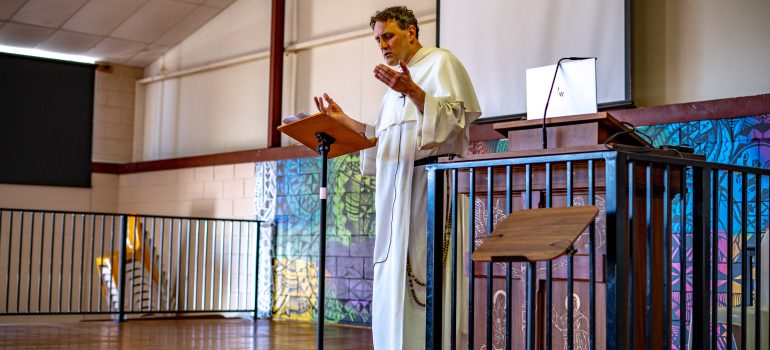
At a conference held in Auckland on 21 February 2026, Fr James Baxter OP delivered a compelling and insightful talk titled “St Dominic, Teacher of Truth.” Although the wider conference focused on St Thomas Aquinas, Fr Baxter intentionally began by returning to the source—the man whose vision made Aquinas possible. To understand Dominican theology, he argued, we must understand the founder whose life shaped the Order of Preachers.
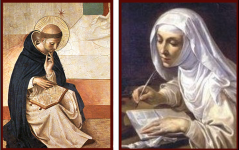
Fr Baxter first situated St Dominic historically. Dominic was born in 1170 in Caleruega, in the Kingdom of Castile, and died in 1221 in Bologna. He lived just over fifty years, and was canonised remarkably quickly in 1234—only a little more than a decade after his death. A contemporary of St Francis of Assisi, Dominic founded the Order of Preachers in 1216 amid the pastoral and doctrinal challenges of southern France.
What distinguishes Dominic from other great founders, Fr Baxter noted, is not a large collection of writings—he left almost none—but rather the way of life he established: a life centred on study, prayer, community, and preaching. His legacy is the Dominican Order itself, which in turn formed saints, scholars, and preachers, including Thomas Aquinas.
Fr Baxter drew on early Dominican sources to paint a vivid portrait of Dominic. Descriptions from those who knew him depict him as radiant, joyful, compassionate, and physically striking. He was remembered especially for his cheerfulness, his tenderness toward the suffering, and his relentless commitment to prayer—often spending nights awake in contemplation.
A central theme of the talk was Dominic’s profound love for truth, grounded in Scripture. As a young man, he studied late into the night, memorised large portions of the Bible, and carried the Gospels and St Paul’s letters with him. His biographers describe him “drinking” from Scripture and finding it “sweeter than honey”—images of nourishment, strength, and delight. His devotion to study was not academic vanity, but a preparation for preaching: truth had to be interiorised before it could be proclaimed.
Dominic founded the Order in response to the Albigensian heresy, which rejected the goodness of the created world and undermined sacramental life. He realised two things were needed: well‑formed preachers who knew the faith deeply, and witnesses whose lives matched their words. Thus, the Dominican pillars of study, preaching, and religious poverty were born.
Fr Baxter then explored how human beings actually come to truth. Drawing on classical rhetoric and Dominican spirituality, he emphasised that truth is not grasped by reason alone. We are moved by love, repelled by fear, shaped by social pressures, and swayed by emotion. To embrace truth, we must first love it. Likewise, we fall into error not only by faulty logic but through haste, laziness, prejudice, or the desire for approval.
Dominic understood this deeply. His holiness, humility, and joy made him a credible preacher; people trusted his words because they trusted his life. His example reminds us that ideas matter, study matters, and virtue matters.
In closing, Fr Baxter proposed St Dominic as a model for all who seek truth today: a man who studied tirelessly, prayed fervently, preached boldly, and loved truth for its own sake—allowing it to shape his mind, calm his spirit, and direct his mission.